What Is an Ideal Customer Profile (ICP)?
An Ideal Customer Profile (ICP) is a clear, written description of the specific type of customer who gets the most value from what you sell — and who's most likely to pay on time, stick around, and refer others.
Strictly speaking, "ICP" and "buyer persona" mean two different things: an ICP describes the company you're targeting (industry, size, budget), while a persona describes the individual person inside it. That split matters for a sales team targeting hundreds of accounts.
It matters less here. If you're running a micro-business, your customer and your decision-maker are usually the same person — so splitting "the company" from "the individual" just adds a step you don't need. We're keeping the term "ICP" in this guide because it's the one you'll see everywhere else (other tools, agencies, guides), and it's worth recognising when you hear it. But the profile you'll build below is really a merged ICP-and-persona: one real ideal customer, with a name, goals, and fears — not a company spec sheet.
It isn't the same as a "target audience" either — a target audience is broad ("small business owners"), while an ICP is specific enough that you could picture one real person and know exactly what to say to them.
The Hidden Cost of Serving Everyone: Why Operating Without a Defined ICP Drains Your Resources
Here's the uncomfortable truth: if you're marketing to everyone, you're connecting with no one. Every pound you spend on advertising, every hour you invest in content, every social media post you craft becomes dramatically less effective when you haven't decided exactly who you're talking to.
It's an easy trap to fall into. Saying no to a type of customer feels like turning down revenue you can't afford to lose — so the message stays vague enough to "work" for everyone. The problem is a vague message doesn't resonate with anyone, no matter how many people it technically applies to. Meanwhile, competitors are winning the customers you wanted, simply because they've made a clear decision about who they serve.
The businesses that pull ahead online aren't necessarily better funded — they've just stopped guessing. They know exactly who they're talking to, what's keeping that person up at night, and — just as importantly — who they're not trying to win over. That clarity is exactly what a defined ICP gives you, and it's the first task in your NetNav Blueprint.
This article walks you through the single most important foundational step in your marketing: defining your Ideal Customer Profile (ICP). This isn't theoretical positioning work. By the end, you'll have completed your first Blueprint task — one that filters every marketing decision you make from this point forward.
Quick Navigation:
Quick Start (20 Minutes)
How do I identify my ICP?
If you need a working customer profile immediately, follow these five steps:
Step 1: Select Your Best Customers
Think of the 2-3 most successful or enjoyable customers you've served in the past year. Not the biggest spenders necessarily, but the ones where everything clicked—they understood your value, paid on time, and you genuinely enjoyed the work.
Write down their names or company names.
Step 2: Document Basic Demographics
For each customer, note down the objective facts:
- •Job title or role
- •Approximate budget or business size
- •Location (if relevant)
- •Industry or sector
Step 3: Define Their Primary Outcome
In one sentence, what was the single biggest result they were seeking from your help? Not what you delivered, but what they were hoping to achieve.
Example: "Reduce the time spent on invoicing from 2 days to 2 hours per month."
Step 4: Create Your One-Paragraph Persona
Synthesise the patterns you see into a single paragraph describing this person. Give them a name if it helps.
Example: "Sarah is a busy architect running a 3-person practice. She's technically skilled but drowns in administrative work every month-end. She needs a simple bookkeeping system that doesn't require her to become an accountant, so she can focus on design work that actually generates revenue."
Step 5: Define Your Anti-Customer
Write one sentence describing who you will not serve, based on past difficult experiences.
Example: "We will not serve DIY enthusiasts who expect free advice or businesses looking for the cheapest possible option regardless of quality."
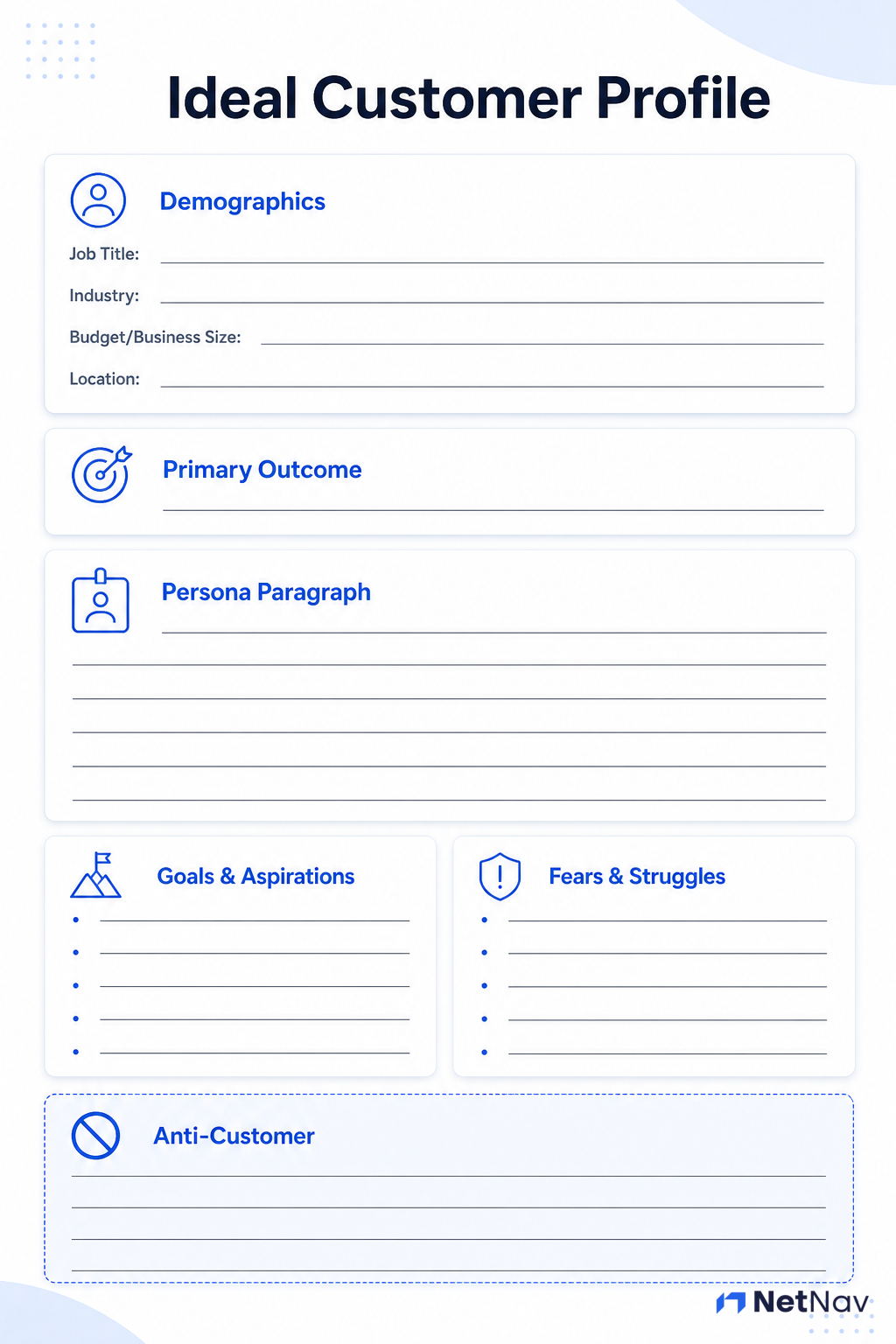
✅ Completed the quick version? You now have a working Customer Profile that will immediately improve your marketing clarity. Move on to List the Real Problems You Solve or continue below for the detailed walkthrough that adds psychological depth.
Complete Step-by-Step Guide: Defining Your Customer Filter
The quick version gives you a functional profile. This complete guide adds the psychological depth that transforms good marketing into magnetic marketing—the kind that makes your ideal customer feel like you're reading their mind.
Step 1: Start with the Exclusions (The Anti-Customer)
Counter-intuitively, the fastest way to clarity is defining who you won't serve. This immediately sharpens your focus and prevents the "everyone is my customer" trap.
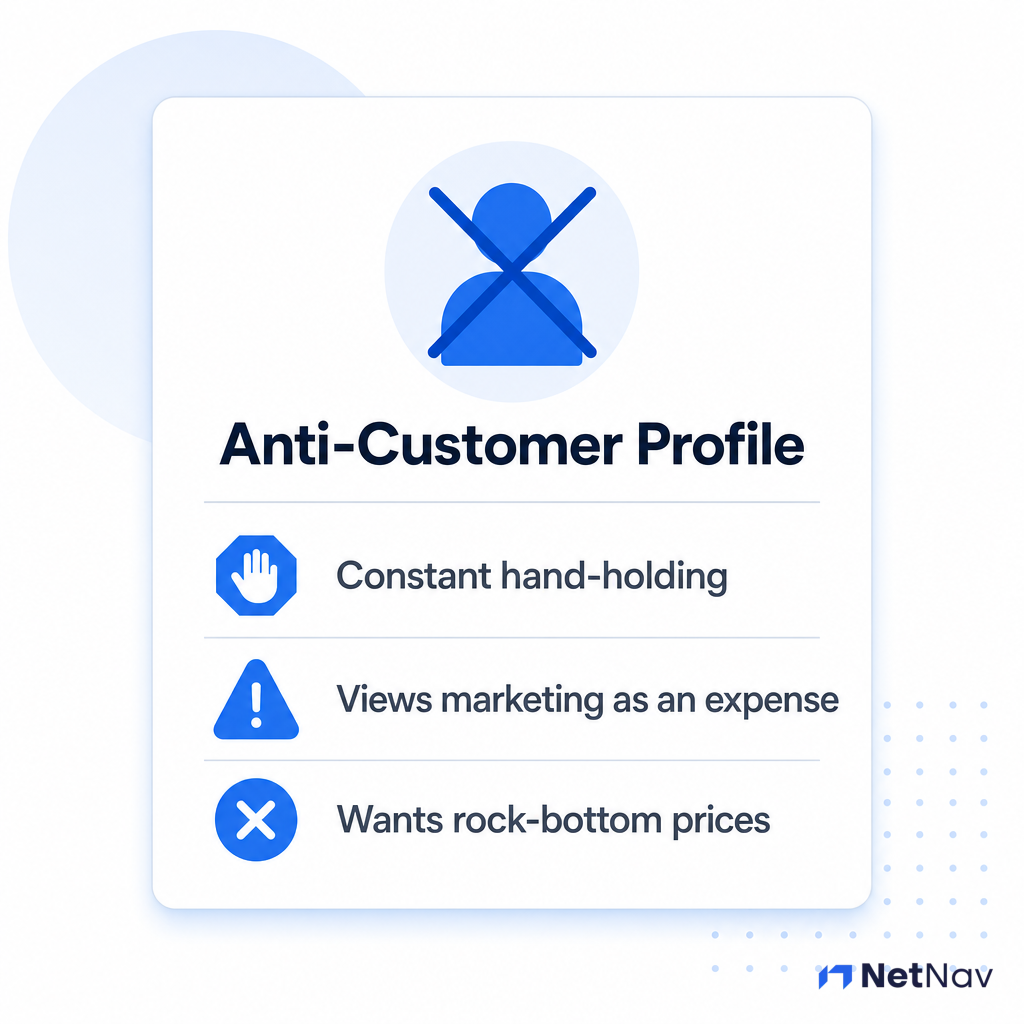
Document three traits or behaviours that immediately disqualify a lead:
Examples:
- •"Customers who need constant hand-holding after delivery"
- •"Businesses that view marketing as an expense rather than an investment"
- •"Clients who want rock-bottom prices and premium service"
This isn't about being difficult. It's about protecting your time, energy, and profit margins. Every hour you spend on a poor-fit customer is an hour you can't spend serving your ideal customer brilliantly.
Step 2: Filter Your Existing Data
Look at your customer list from the past 12-24 months. Identify the top 20% who provided the most profit and satisfaction. Not one or the other—both.
Ask yourself:
- •Which projects did I genuinely enjoy?
- •Which customers referred others?
- •Which engagements were profitable without being painful?
- •Which customers "got it" immediately without extensive convincing?
This is where the value of niching down becomes tangible. You're not inventing a customer from thin air—you're identifying the pattern that already exists in your best work.
Step 3: Gather Psychographics (The 'Why')
This is where most business owners stop too early. Demographics tell you who someone is. Psychographics tell you why they buy.
For your ideal customer, document:
Their Fears:
- •What keeps them awake at night?
- •What are they afraid will happen if they don't solve this problem?
- •What have they already tried that failed?
Their Aspirations:
- •What does success look like to them?
- •How will their life or business be different once this problem is solved?
- •What will they be able to do that they can't do now?
Their Internal Struggles:
- •What's stopping them from solving this themselves?
- •What do they feel guilty or embarrassed about?
- •What do they wish they were better at?
If you don't know these answers, use simple research methods—or simply recall three real conversations with past customers. The gold is in the actual words they used, not marketing jargon.
Defining your customer's deepest fears and motivations is the hardest part. The NetNav messaging audit uses AI to compare your site content against best practices to ensure you hit these emotional triggers instantly.
Step 4: Gather Demographics (The 'Who')
Now document the objective data that helps you find more people like this:
Professional Demographics:
- •Job title or role
- •Industry or sector
- •Company size (if B2B)
- •Decision-making authority
- •Budget range
Personal Demographics (if relevant):
- •Age range
- •Location
- •Education level
- •Income bracket
The critical distinction: demographics help you find your customer. Psychographics help you convert them. You need both, but psychographics are what make your marketing feel personal rather than generic.
Step 5: Map Their Awareness Stage
Not all customers are at the same point in their buying journey. Decide where your ideal customer sits:
Problem-Aware: They know they have a problem but don't know solutions exist yet. They're searching for information, not providers.
Solution-Aware: They know solutions exist and are actively comparing options. They're ready to buy from someone—the question is who.
This determines your entire content strategy. Problem-aware customers need education. Solution-aware customers need differentiation and proof.
Step 6: Synthesise Your Persona
Take everything you've documented and create a concise summary that includes their motivations. Give your persona a name and, if it helps, find a stock photo that represents them.
Example:
"David, the Overwhelmed Consultant"
David runs a successful 2-person consulting firm but spends 15 hours per week on administrative tasks he hates. He's technically capable but has no interest in becoming a marketing expert—he just wants a system that works without constant tinkering. He's tried DIY solutions and cheap freelancers, both of which cost him more time than they saved. He's now willing to invest properly but is terrified of being sold something overcomplicated that he'll never actually use. Success for David means reclaiming his evenings and weekends whilst knowing his marketing is working in the background.
Notice how this goes far beyond "consultants aged 35-50." You can feel David's frustration. You understand what he's tried and why it failed. You know what he values and what he fears.
Step 7: Create the 'We Serve' and 'We Don't Serve' Statement
Distil everything into two clear statements that you can use to filter future marketing decisions:
We Serve:
"We serve ambitious micro-business owners who are willing to invest in proper marketing systems but don't have time to become marketing experts themselves."
We Don't Serve:
"We don't serve businesses looking for the cheapest option, DIY enthusiasts who want free advice, or companies that need constant hand-holding."
These statements become your filter for every marketing decision: Does this content speak to the people we serve? Does this channel reach them? Does this message address their fears and aspirations?
Understanding their potential objections before they voice them is what separates adequate marketing from exceptional marketing.
🎉 Completed? You now have a laser-focused understanding of who you're talking to. You're ready for the next Blueprint step: List the Real Problems You Solve.
Troubleshooting
I feel like I'm excluding too many people by being this specific. Isn't that risky?
Focus creates clarity, not limitation. You're not refusing to serve others — you're choosing to master marketing to a specific group first. Once you've proven your system works for one clearly defined segment, you can expand. Trying to market to everyone from day one means you'll connect with no one. The businesses winning customers right now aren't more talented than you — they're simply more focused.
What if I serve two completely different types of customers, like B2B and B2C, or two industries?
Choose one to focus your marketing on first, or commit to creating two entirely separate ICPs with separate messaging systems. Don't try to blend them — each needs its own website section, content strategy, and value proposition. Most micro-businesses don't have the resources to market to two distinct audiences at once, so pick the more profitable or enjoyable one, master that, then expand.
I don't know enough about my customers' fears and goals — it feels like guesswork. What do I do?
You have three options: interview 3-5 past customers directly, recall three real conversations and write down the actual words they used to describe their problems, or start with your best educated guess and refine it as you gather more data. An imperfect ICP that you refine is better than no ICP at all — your first version needs to be documented, not perfect.
Where This Fits
Your Ideal Customer Profile isn't a document you create once and forget. It's the foundation that every other marketing decision builds upon.
This profile directly feeds into your 1-page marketing plan, determines your content topics, shapes your website copy, and filters which marketing channels you invest in.
When you're deciding whether to write a blog post, create a social media campaign, or invest in advertising, you'll ask: "Does this speak to David, the Overwhelmed Consultant?" If yes, proceed. If no, don't waste the time.
What's Next
You've defined who you're talking to. The next Blueprint step is defining what you're saying to them: List the Real Problems You Solve.
That article translates the fears and goals you've documented here into a concrete list of problems you're uniquely positioned to solve. It's where your customer focus becomes your marketing message.
Go Deeper
Want to expand your understanding of your customer?
- Map Your Customer Journey in 30 Minutes – For a more complete view of how your customer buys, map out the entire customer journey from first awareness to repeat purchase.
- Building a Personal Brand vs Company Brand – If you're struggling to define the voice for your ICP, this guide helps decide if you should focus on personal or company branding.
- Template: New Business Marketing Checklist – See where this customer definition step fits into the full marketing launch timeline.
Other Foundations Guides
- •Write Your Simple Brand Story
- •Quick Competitor Scan
- •Set Simple Marketing Goals You Can Track
- •Create Your Unique Selling Point (USP) Worksheet
- •Pricing Basics for Micro Businesses
- •Template: Marketing Budget Calculator
Ready to Validate Your Customer Focus?
You've completed the most critical step: defining your customer. NetNav can audit your entire site across 9 pillars in 60 seconds—compare your defined ICP against the messaging you currently have online.